The Essential AI Trends Shaping Business Today
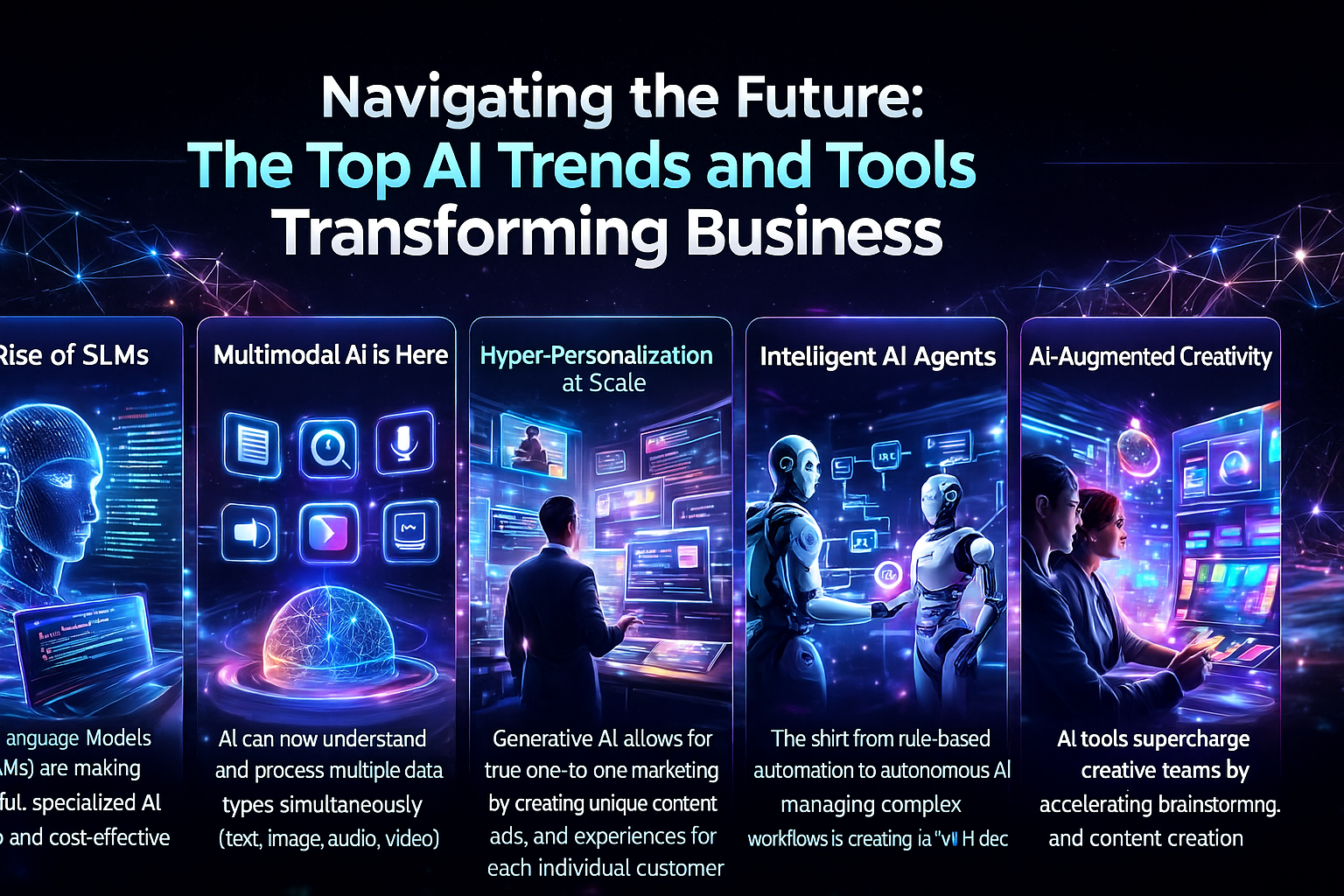
Navigating the Future: The Top AI Trends and Tools Transforming Business
- The Rise of SLMs: Small Language Models (SLMs) are making powerful, specialized AI more accessible and cost-effective for niche business tasks, moving away from the one-size-fits-all approach.
- Multimodal AI is Here: AI can now understand and process multiple data types simultaneously (text, image, audio, video), unlocking deeper insights and more sophisticated applications like real-time quality control and interactive training.
- Hyper-Personalization at Scale: Generative AI allows for true one-to-one marketing by creating unique content, ads, and experiences for each individual customer, dramatically boosting engagement and conversions.
- Intelligent AI Agents: The shift from simple, rule-based automation to autonomous AI agents that can manage complex, multi-step workflows is creating a “virtual workforce” to enhance productivity.
- AI-Augmented Creativity: AI tools are supercharging creative teams by accelerating brainstorming, prototyping, and content variation, acting as powerful assistants rather than replacements.
The world of artificial intelligence is moving at an unprecedented pace. What was once the domain of science fiction is now a daily reality for businesses striving for a competitive edge. Staying current with the latest AI trends and tools is no longer just an advantage; it’s a necessity for survival and growth in the modern digital landscape. From hyper-efficient small language models to AI that can see, hear, and speak, the capabilities at our disposal are evolving by the day. For business professionals, entrepreneurs, and tech-forward leaders, the key isn’t just knowing about these changes but understanding how to strategically harness them to optimize workflows, enhance customer experiences, and unlock new avenues for innovation.
At AITechScope, we live and breathe this evolution. As specialists in AI-powered automation and virtual assistant services, we’re constantly on the front lines, integrating these breakthrough technologies to drive real-world business results. This post synthesizes the most significant developments shaping the industry today. We’ll move beyond the hype to provide a clear, actionable guide to the trends that matter, the tools you should know, and how you can leverage them to propel your business forward.
The Core AI Trends and Tools Shaping the Industry
The current AI landscape is defined by a move toward more accessible, specialized, and integrated solutions. The monolithic, one-size-fits-all approach is giving way to a diverse ecosystem of tools designed for specific business functions. Here are the pivotal trends you need to watch.
Trend 1: The Power of Small — The Rise of Specialized Language Models (SLMs)
For the past few years, the AI conversation has been dominated by massive, general-purpose models like GPT-4. While incredibly powerful, these “frontier models” are often resource-intensive and expensive to run, making them overkill for many specific business tasks. The latest trend is a significant shift toward Small Language Models (SLMs).
SLMs are highly-trained, efficient models designed to excel at a narrower range of tasks. Think of them as specialist surgeons rather than general practitioners. Models like Mistral’s 7B, Google’s Gemma, and Meta’s Llama 3 8B are demonstrating remarkable performance that rivals their larger counterparts on specific benchmarks, but with a fraction of the computational cost and energy consumption.
Why This Matters for Your Business:
This trend democratizes access to powerful AI. Businesses can now deploy sophisticated AI for niche applications without the prohibitive costs associated with flagship models. SLMs are perfect for tasks like:
- Internal Knowledge Base Queries: An SLM can be fine-tuned on your company’s internal documentation to provide employees with instant, accurate answers to questions about policies, procedures, or technical specifications.
- Customer Support Triage: A specialized model can analyze incoming support tickets, categorize them by urgency and topic, and route them to the correct department, dramatically reducing response times.
- Data Extraction and Summarization: SLMs can be trained to pull specific information from standardized documents like invoices, contracts, or reports, automating tedious data entry tasks.
Practical Takeaway: Re-evaluate your AI needs. Instead of defaulting to the largest, most expensive model, consider if a more focused, cost-effective SLM could achieve your goals more efficiently. This “right-sizing” approach is key to achieving a positive ROI on your AI investments.
How AITechScope Helps: Our AI consulting services specialize in identifying the perfect model for your unique business case. We help you navigate the complex landscape of open-source and proprietary models to select, fine-tune, and integrate the right-sized AI into your operations, often using powerful workflow automation platforms like n8n to connect everything seamlessly.
Trend 2: Beyond Text — The Multimodal AI Revolution
The next frontier of AI is not just about understanding words; it’s about understanding the world. Multimodal AI refers to models that can process, understand, and generate information across different data types—text, images, audio, and video—simultaneously. Google’s Gemini 1.5 Pro and OpenAI’s GPT-4o are leading this charge, showcasing astounding capabilities.
Imagine feeding an AI a video of a team meeting. It could not only provide a perfect transcript (audio to text) but also summarize the key decisions, identify the speakers (image recognition), and even analyze the overall sentiment of the meeting based on tone of voice (audio analysis). This is the power of multimodality.
Why This Matters for Your Business:
Multimodality unlocks vast, previously untapped sources of data and enables far more sophisticated applications. It bridges the gap between the digital and physical worlds, allowing AI to interact with your business in a much more holistic way. Potential applications include:
- Enhanced Quality Control: An AI model could analyze video feeds from a manufacturing line to spot defects in real-time that are invisible to the human eye.
- Intelligent Market Research: Analyze social media posts that include images and videos of your products to gain deeper, more contextual insights into how customers are using them.
- Interactive Training & Onboarding: Create dynamic training modules where employees can ask questions about a video tutorial, and the AI provides answers based on the visual and audible content.
Practical Takeaway: Start thinking about your business processes in terms of multiple data streams. Where are you currently relying only on text-based information when valuable insights could be gleaned from images, call recordings, or video walkthroughs?
How AITechScope Helps: We build custom automation solutions that leverage the power of multimodal AI. Our n8n experts can create workflows that automatically process customer video testimonials, transcribe and analyze sales calls for coaching opportunities, or monitor visual data streams for business intelligence.
Trend 3: From Mass Marketing to Hyper-Personalization at Scale
For decades, personalization in marketing meant little more than inserting a customer’s first name into an email template. Generative AI is changing that paradigm completely. The new wave of AI-powered marketing tools enables true hyper-personalization, creating unique experiences, content, and recommendations for every single user, at scale.
This is achieved by feeding AI models vast amounts of customer data—browsing history, purchase records, support interactions, and demographic information. The AI can then generate bespoke email copy, personalized product landing pages, and even unique ad creatives that resonate with an individual’s specific needs and preferences.
Why This Matters for Your Business:
Hyper-personalization is proven to drastically increase customer engagement, loyalty, and conversion rates. When customers feel understood, they are far more likely to buy. This trend moves marketing from a one-to-many broadcast model to a one-to-one conversation model.
Practical Takeaway: Audit your customer journey and identify key touchpoints where personalization could have the most impact. This could be in your welcome email series, on your product recommendation engine, or in your retargeting ad campaigns.
How AITechScope Helps: We connect the dots between your CRM, your marketing platforms, and cutting-edge generative AI. We can design and implement automated workflows that trigger personalized content creation based on customer behavior, helping you build stronger relationships and drive more revenue without manual intervention.
Trend 4: The Automation Leap — Intelligent AI Agents Are Here
The most transformative AI trend for business operations is the evolution from simple automation to intelligent, autonomous agents. Traditional automation, like that found in Zapier or basic RPA, is typically linear and rule-based: “If X happens, then do Y.” AI agents represent a fundamental leap forward.
An AI agent is a system that can perceive its environment, make decisions, and take actions to achieve a specific goal. It can handle complex, multi-step tasks that require planning and adaptation. For example, you could give an agent a goal like: “Find the top three catering options for our company event of 50 people, get quotes, and summarize them in a spreadsheet.” The agent would independently browse the web, interact with websites, fill out forms, and compile the final report.
Why This Matters for Your Business:
AI agents are the ultimate expression of intelligent delegation. They can take over entire workflows, not just individual tasks, freeing up your human team to focus exclusively on high-level strategy, creativity, and relationship-building. This is the next level of digital transformation, creating a true “virtual workforce” that operates 24/7.
Practical Takeaway: Identify a complex, repetitive, and time-consuming workflow in your business. This could be lead qualification, market research, competitor analysis, or onboarding new clients. These are prime candidates for being managed by an intelligent AI agent.
How AITechScope Helps: This is our core specialty. Using powerful, flexible platforms like n8n, we build and deploy sophisticated AI agents that function as highly efficient virtual assistants. We design these agents to integrate perfectly with your existing tools (CRM, email, project management software) and execute complex processes flawlessly, driving massive gains in productivity and efficiency.
Trend 5: AI in the Arts — Redefining Creative Workflows
While often discussed in the context of business analytics and operations, AI is also having a profound impact on creative industries. Tools like Midjourney for image generation, Suno for music creation, and even niche applications like Strudel for learning musical concepts through code, are democratizing creative expression and augmenting the capabilities of human artists.
For businesses, this trend is less about replacing creative teams and more about supercharging them. AI can be used as a powerful brainstorming partner, a rapid prototyping tool, or an engine for generating variations on a theme, allowing creatives to explore more ideas in less time.
Why This Matters for Your Business:
AI can dramatically accelerate your content creation pipeline for marketing and branding. It can generate dozens of ad copy variations for A/B testing, create unique stock imagery for your blog posts, or even produce background music for your corporate videos.
Practical Takeaway: Encourage your marketing and design teams to experiment with generative AI tools. Frame them not as a replacement, but as an assistant that can handle the more tedious aspects of creative work, freeing them up for higher-level conceptual thinking.
How AITechScope Helps: We can build automated content creation pipelines for your business. Imagine a workflow where a new blog post topic is entered, and an AI agent researches the topic, suggests an outline, generates draft copy, and even creates a series of relevant social media graphics—all automatically. This is the kind of efficiency we deliver.
Your Partner in AI Transformation: AITechScope
Understanding these AI trends and tools is the first step. The next, more critical step is strategic implementation. This is where a knowledgeable partner can make all the difference. At AITechScope, we are more than just virtual assistants; we are architects of intelligent business systems.
Our expertise is centered on turning the potential of AI into tangible business outcomes.
- AI Consulting & Strategy: We don’t just recommend tools; we help you build a comprehensive AI strategy that aligns with your business goals. We start with our AI TechScope audit to identify the highest-impact opportunities for automation and optimization within your current operations.
- n8n Automation & AI Agent Development: As experts in n8n, one of the most powerful and flexible workflow automation platforms available, we build the custom AI agents that execute your complex processes. We connect all your apps and services into a cohesive, intelligent ecosystem.
- AI-Powered Website Development: Your website is often the first point of contact with customers. We build modern, efficient websites and integrate AI-powered features like intelligent chatbots, personalized content delivery, and automated lead capture to turn your site into a 24/7 sales and support machine.
The future of business is intelligent, automated, and efficient. By embracing these trends and partnering with experts who can guide you through the complexities of implementation, you can not only keep pace but define the future of your industry.
Ready to harness the power of AI for your business?
Don’t let the complexity of AI hold you back from its incredible benefits. Let our team of experts show you the way.
Frequently Asked Questions (FAQ)
What is the main difference between an SLM and a large model like GPT-4?
The primary differences are size, cost, and specialization. Large Language Models (LLMs) like GPT-4 are massive, general-purpose models designed to handle a vast range of tasks, but they are expensive and resource-intensive to run. Small Language Models (SLMs) are much smaller, more efficient, and are often fine-tuned to excel at a specific set of tasks (e.g., summarizing legal documents or triaging support tickets). This makes them a more cost-effective and faster solution for many dedicated business applications.
Is multimodal AI something only large tech companies can afford to use?
Not anymore. While the foundational multimodal models are developed by large companies like Google and OpenAI, access to their capabilities is available through APIs at a relatively low cost. This allows businesses of all sizes to integrate multimodal features into their workflows. For example, a small e-commerce business could use an API to automatically transcribe and analyze customer video reviews without needing to build the underlying AI model themselves.
How is an “AI agent” different from the automation I use in a tool like Zapier?
Traditional automation is typically linear and rule-based, following a simple “if this, then that” logic. For example, “When I get an email with ‘invoice’ in the subject, save the attachment to Dropbox.” An AI agent is far more advanced. It is autonomous and goal-oriented. You give it a complex objective, and it independently plans and executes a series of steps to achieve it, adapting as it goes. It can browse the web, make decisions, and use multiple tools, functioning more like a human assistant than a rigid, pre-programmed workflow.
Will AI tools replace creative professionals?
The current trend suggests AI is more of a powerful collaborator than a replacement for creative professionals. AI can handle tedious tasks, generate a wide array of ideas for brainstorming, and create variations for testing, which accelerates the creative process. This frees up human designers, writers, and artists to focus on strategy, conceptual thinking, and refining the final product. The most effective creative teams will be those who learn to leverage AI to augment their own skills, not those who try to compete against it.
Share this content: