
Mastering AI Prompt Engineering: Write Effective Prompts with Confidence
The difference between mediocre and exceptional AI outputs often comes down to one critical skill: prompt engineering. As AI tools like ChatGPT, Bard, and Midjourney become integral to business operations and personal productivity, the ability to craft effective AI prompts has emerged as a valuable competency. This guide will equip you with the knowledge, frameworks, and practical exercises to transform your AI interactions from basic to brilliant.
The Importance of Prompt Engineering in AI Applications
Prompt engineering is the art and science of crafting instructions that elicit optimal responses from AI systems. Think of it as learning to communicate effectively with a powerful but literal-minded assistant. The quality of your prompts directly impacts the usefulness of AI-generated outputs in several key ways:
Business Applications
In professional settings, effective prompts can transform AI from a novelty into a productivity multiplier. Marketing teams can generate campaign concepts, data analysts can extract meaningful insights, and content creators can overcome creative blocks—all through well-crafted prompts that align with business objectives.
Personal Productivity
For individual users, mastering prompt engineering means getting more done with less effort. Whether you’re drafting emails, planning projects, or learning new concepts, the right prompting techniques can save hours of work while producing higher-quality results.
According to recent studies, professionals who master prompt engineering report up to 40% higher satisfaction with AI outputs and 30% less time spent refining results.
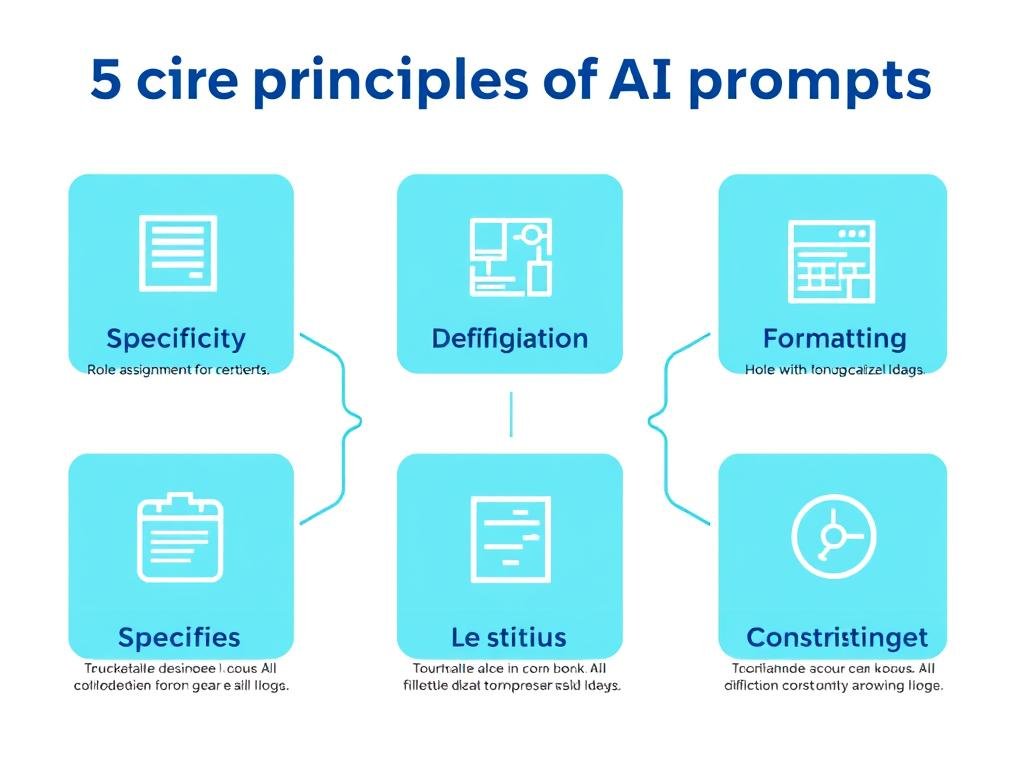
5 Core Principles for Crafting Effective AI Prompts
The foundation of successful prompt engineering rests on understanding how AI models interpret and respond to your instructions. These five principles will help you create prompts that consistently generate valuable outputs:
- Specificity and Context: Provide clear details about what you want and why you need it. The more specific your prompt, the more targeted the response.
- Role Assignment: Define a role or perspective for the AI to adopt, which frames its response approach and expertise level.
- Format Definition: Explicitly state your desired output format (bullet points, tables, paragraphs, etc.) to ensure usable results.
- Example Inclusion: Demonstrate what you want by including examples of desired outputs or response patterns.
- Constraint Setting: Establish boundaries for the AI’s response, including length limitations, tone requirements, or specific exclusions.
Master Advanced Prompt Engineering
Dive deeper into these principles with “AI Next Step Prompt Engineering” – a comprehensive guide to crafting prompts that deliver exceptional results for any use case.
Step-by-Step Framework to Tweak AI Outputs
Even with well-crafted initial prompts, achieving optimal results often requires refinement. This framework helps you systematically improve outputs through strategic iterations:
| Step | Action | Example |
| 1. Baseline Prompt | Create an initial prompt with core request | “Write a product description for a wireless keyboard.” |
| 2. Evaluation | Identify specific areas for improvement | Output lacks technical details and target audience focus |
| 3. Refinement | Add specificity, context, and constraints | “Write a product description for a wireless ergonomic keyboard targeting professional developers. Include battery life, connectivity options, and ergonomic benefits. Keep it under 200 words with a professional tone.” |
| 4. Iteration | Further adjust based on new output | “The description is good but needs more emphasis on productivity benefits. Revise to highlight time-saving features and include a compelling call-to-action.” |
| 5. Finalization | Polish and optimize final output | “Perfect the description by adding one customer testimonial quote and formatting key features as bullet points for scanability.” |
Before and After Example
Initial Prompt: “Give me ideas for a marketing campaign.”
Initial Output: Generic marketing suggestions without specific direction or applicability.
Refined Prompt: “As an experienced digital marketing strategist, suggest 5 campaign ideas for a new organic skincare line targeting environmentally-conscious millennials with a $10,000 budget. Focus on social media and influencer approaches. Include estimated costs and potential ROI for each idea.”
Refined Output: Targeted, actionable campaign ideas with budget considerations and expected outcomes.
Perfect Your Output Refinement Skills
Learn advanced techniques for tweaking AI outputs with “The Art of Prompt Engineering” – your guide to getting exactly what you need from AI tools.
Practical Exercises for Different Use Cases
Theory becomes valuable when applied to real-world scenarios. These exercises will help you develop prompt engineering skills across various professional domains:
Marketing Content Creation
Exercise: Campaign Concept Generation
Practice creating prompts that generate marketing campaign concepts for different products and target audiences.
Base Prompt: “Create a marketing campaign for a fitness app.”
Enhanced Prompt: “As a creative marketing director, develop a comprehensive social media campaign for a fitness app targeting busy professionals aged 30-45. Include: 1) Campaign theme and tagline, 2) Three content pillars, 3) Two partnership opportunities, 4) Call-to-action strategy. The brand voice is motivational but not aggressive, and the unique selling point is AI-personalized workout plans that require only 20 minutes daily.”
Key Learning: Adding audience specificity, brand voice guidelines, and structured output requirements dramatically improves the usefulness of marketing content generated by AI.
Data Analysis and Insights
Exercise: Data Interpretation Prompting
Learn to craft prompts that help extract meaningful insights from complex data sets.
Base Prompt: “Analyze this sales data.”
Enhanced Prompt: “You are a data analyst specializing in retail trends. Examine the following quarterly sales data for a clothing retailer with stores in 5 regions. Identify: 1) The top-performing region and potential reasons for its success, 2) Seasonal patterns across all regions, 3) Products with declining sales that require attention, 4) Three actionable recommendations based on these insights. Present your analysis in a structured format with clear section headings.”
Key Learning: Specifying the analytical approach, required insights, and presentation format helps transform raw data into actionable business intelligence.
Content Translation and Localization

| Language | Sample Prompt Translation | Cultural Adaptation Note |
| Spanish | “Como experto en marketing digital, crea una estrategia para atraer clientes en el mercado español.” | Include references to local holidays and regional preferences |
| German | “Als Fachmann für digitales Marketing erstellen Sie eine Strategie zur Kundengewinnung im deutschen Markt.” | Emphasize precision, quality, and data privacy concerns |
| Japanese | “デジタルマーケティングの専門家として、日本市場で顧客を引き付けるための戦略を作成してください。” | Focus on group harmony, respect hierarchies, and seasonal references |
Access 50+ Practical Prompt Exercises
Develop your skills with “Practical AI Prompt Engineering” – featuring exercises designed for real-world business applications across multiple industries.
Pro Tips for Optimizing AI Tool Outputs
Beyond the fundamentals, these advanced techniques will help you get the most from today’s leading AI platforms:
ChatGPT Optimization
- Use system prompts to set persistent behavior parameters
- Leverage the “temperature” setting to control creativity vs. precision
- Break complex tasks into sequential prompts for better results
- Utilize code blocks for technical content formatting
- Implement chain-of-thought prompting for complex reasoning tasks
Google Bard Techniques
- Explicitly request citations for factual information
- Use “draft with me” for collaborative writing
- Leverage Bard’s real-time data access for current information
- Request multiple perspectives on complex topics
- Utilize Bard’s image analysis capabilities in prompts
Midjourney Mastery
- Structure visual prompts with subject, medium, style, lighting, and mood
- Use aspect ratio parameters for specific output dimensions
- Incorporate reference images with “imagine prompt –reference URL”
- Apply stylistic weights with double colons (::5)
- Utilize negative prompts to exclude unwanted elements
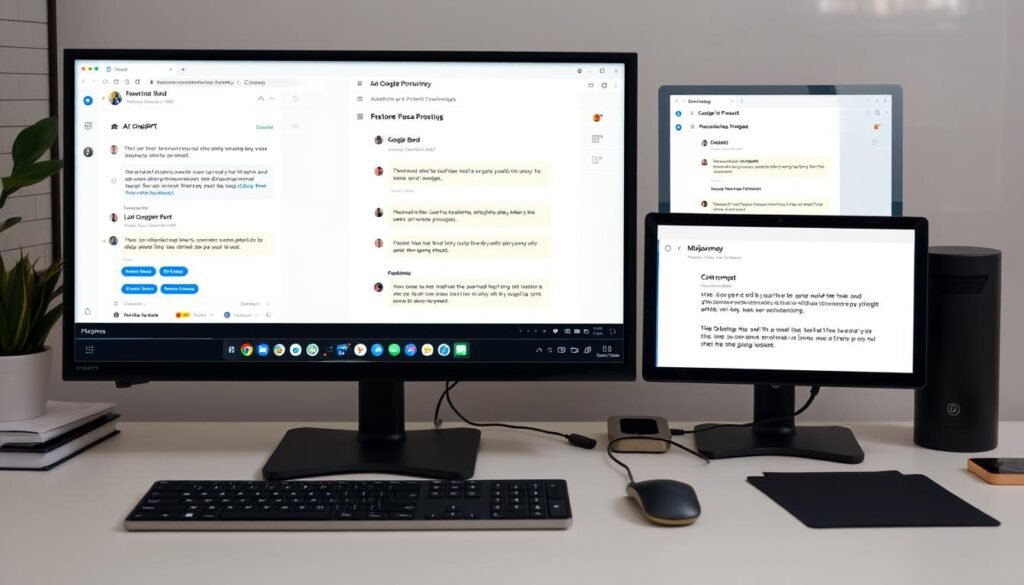
Platform-Specific Syntax: Each AI platform has unique command structures and capabilities. Learning platform-specific syntax can significantly enhance your results. For example, ChatGPT responds well to role-based prompting, while Midjourney offers powerful parameter controls for visual generation.
Case Study: The Prompt Refinement Process
Follow this real-world example of how a marketing professional refined their prompts across three iterations to achieve exceptional results:
Business Challenge: Creating Product Launch Email Sequence
A digital marketing manager needed to create a 5-email sequence for a software product launch targeting enterprise clients.
Iteration 1: Basic Prompt
“Write an email sequence for a product launch.”
Result: Generic emails lacking specific audience targeting, product differentiation, or strategic progression.
Iteration 2: Improved Prompt
“Create a 5-email sequence for launching a project management software to enterprise clients. Include subject lines and focus on benefits for large teams.”
Result: Better targeted emails but still missing strategic progression, competitive differentiation, and specific call-to-action elements.
Iteration 3: Optimized Prompt
“As an enterprise SaaS marketing specialist, design a strategic 5-email sequence for launching ‘ProjectPro’ – an AI-enhanced project management platform for companies with 500+ employees. For each email, provide: 1) Subject line with open rate prediction, 2) Body copy (250-300 words), 3) Primary call-to-action, 4) Timing recommendation (days before/after launch). The sequence should address these stages: problem awareness, solution introduction, competitive differentiation, case study/proof, and limited-time offer. Our brand voice is professional but conversational, and our primary competitors are Asana and Monday.com. Our key differentiator is our AI resource allocation feature that reduces project completion time by 30%.”
Result: Comprehensive, strategic email sequence with compelling subject lines, targeted messaging, clear progression, and effective calls-to-action tailored to enterprise decision-makers.
Frequently Asked Questions About Prompt Engineering
How long should an effective AI prompt be?
Effective AI prompts can range from a single sentence to several paragraphs depending on the complexity of your request. For simple tasks, concise prompts often work well. For complex outputs requiring specific parameters, longer prompts with detailed instructions typically yield better results. The key is including relevant details without unnecessary information. Start with the minimum information needed, then add specificity if the initial results don’t meet your needs.
Can I use the same prompting techniques across different AI platforms?
While core principles of effective prompting (specificity, context, role assignment) work across most platforms, each AI system has unique capabilities and syntax. ChatGPT responds well to role-based prompting and chain-of-thought reasoning. Midjourney requires specific parameter formatting for visual generation. Bard has distinct commands for accessing its knowledge base. Learn platform-specific techniques while applying universal principles for optimal results.
How do I handle AI hallucinations or inaccurate information?
To minimize AI hallucinations (fabricated information presented as fact), implement these strategies: 1) Request that the AI cite sources or indicate when it’s uncertain, 2) Ask for the same information in different ways to check consistency, 3) Verify important facts through reliable sources, 4) For factual tasks, explicitly instruct the AI to decline answering if it lacks sufficient information rather than guessing. When you receive inaccurate information, provide feedback and correction to refine future responses.
What’s the difference between prompt engineering and prompt design?
While often used interchangeably, prompt engineering typically refers to the technical aspects of optimizing prompts for specific AI models and applications, often involving parameter tuning and understanding model behavior. Prompt design focuses more on the creative and strategic elements of crafting effective instructions. Both are important: engineering ensures technical optimization while design ensures the prompt aligns with user goals and communication principles.
How can I measure the effectiveness of my prompts?
Evaluate prompt effectiveness using these metrics: 1) Relevance – how well the output addresses your specific needs, 2) Accuracy – factual correctness of the information, 3) Completeness – whether all requested elements are included, 4) Efficiency – number of iterations needed to achieve desired results, 5) Consistency – reliability of results when using similar prompts. For business applications, track time saved and quality improvements compared to non-AI methods.

Conclusion: Your Journey to Prompt Engineering Mastery
Mastering the art and science of prompt engineering is an iterative process that improves with practice and experimentation. By applying the principles, frameworks, and techniques outlined in this guide, you’ll develop the skills to consistently generate high-quality AI outputs that serve your specific business and personal needs.
Remember that effective prompt engineering is about clear communication, strategic thinking, and understanding both the capabilities and limitations of AI systems. As these technologies continue to evolve, your ability to craft effective prompts will remain a valuable skill that sets you apart in an increasingly AI-integrated world.
Benefits of Mastering Prompt Engineering
- Significantly improved quality and relevance of AI outputs
- Reduced time spent refining and correcting generated content
- Ability to leverage AI for more complex and nuanced tasks
- Greater return on investment from AI tool subscriptions
- Competitive advantage in AI-assisted workflows
Challenges to Overcome
- Learning curve for platform-specific techniques
- Need for ongoing adaptation as AI capabilities evolve
- Potential over-reliance on AI for critical thinking tasks
- Balancing prompt specificity with creative exploration
- Verifying accuracy of AI-generated information
Take Your AI Skills to the Next Level
Ready to master the art of prompt engineering? Explore our recommended resources to accelerate your learning journey and transform how you work with AI.

Share this content:










Post Comment