
Best Ai Tools in the US – Tools, Software & 2025 Trends
Is your business struggling to keep up with the explosive demand for automation, data analysis, and personalized user experiences? As artificial intelligence evolves from buzzword to business imperative, identifying the best AI tools becomes critical—not just for tech teams, but for marketers, developers, and decision-makers alike.
Whether through best AI tools review insights or real-world applications, choosing the right AI stack transforms workflows, slashes operational costs, and unlocks unprecedented innovation. This guide cuts through the noise to explore the best AI tools use cases, technical architectures, and optimization strategies powering today’s AI-first enterprises.
CORE CONCEPT / TECHNOLOGY OVERVIEW
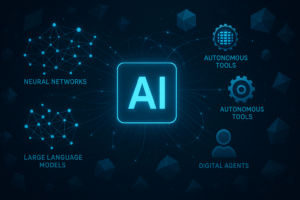
Modern AI tools leverage machine learning (ML), natural language processing (NLP), and generative adversarial networks (GANs) to automate tasks, predict outcomes, and create content. Unlike legacy systems, today’s AI operates across hybrid environments—edge devices, cloud platforms, or serverless frameworks—delivering context-aware intelligence in milliseconds. Core functionalities include:
– Generative AI: Tools like OpenAI’s GPT-4 or Google’s Gemini synthesize text, code, or visual assets.
– Predictive Analytics: Platforms such as DataRobot automate forecasting using time-series algorithms.
– Computer Vision: Frameworks like YOLOv8 enable real-time object detection for manufacturing or healthcare.
– RPA (Robotic Process Automation): UiPath and Automation Anywhere integrate AI to handle repetitive tasks.
Industry adoption spans healthcare diagnostics (e.g., PathAI’s pathology analysis), supply chain optimization (ClearMetal’s predictive logistics), and conversational AI (Intercom’s GPT-4-driven chatbots).
TOOLS / SYSTEM REQUIREMENTS
Implementing AI requires a blend of software, hardware, and cloud infrastructure:
– Frameworks: PyTorch, TensorFlow, or Keras for custom model development.
– APIs: OpenAI API, Anthropic Claude, or AWS Bedrock for pre-trained LLMs.
– Development Environments: Jupyter Notebooks, VS Code with Copilot, or Google Colab.
– Cloud Platforms: AWS SageMaker, Azure ML, or Google Vertex AI for MLOps pipelines.
– Edge Hardware: NVIDIA Jetson for IoT deployments or Apple Neural Engine for on-device AI.
Minimum System Specs:
– CPU/GPU: NVIDIA A100 (Cloud) or RTX 4070 (Local) for LLM fine-tuning.
– RAM: 32GB+ for large dataset processing.
– Storage: NVMe SSDs for reduced model load latency.
WORKFLOW & IMPLEMENTATION GUIDE

Step 1: Define Use Case & Tool Selection
Conduct a best AI tools review to match needs with capabilities. For example:
– Content Creation: Jasper.ai or Copy.ai
– Data Analysis: Tableau CRM + Einstein AI
– Code Generation: GitHub Copilot or Codeium
Step 2: Environment Setup
1. Provision cloud GPU instances via AWS EC2 (p4d.24xlarge for heavy workloads).
2. Install CUDA 12.1 and cuDNN 8.9 for GPU acceleration.
3. Containerize tools using Docker to avoid dependency conflicts.
Step 3: Data Preparation & Model Integration
“`python
from transformers import pipeline
Load a pre-trained summarization model
summarizer = pipeline(“summarization”, model=”facebook/bart-large-cnn”)
Generate summary
summary = summarizer(“Your_long_text_here”, max_length=130)
“`
Step 4: Optimization
– Quantization: Reduce model size via TensorRT without losing accuracy.
– Caching: Implement Redis for frequent inference requests.
– Benchmarking: Use MLPerf metrics to validate performance gains.
The best AI tools use cases emerge when refining feedback loops—e.g., retraining a chatbot monthly with user interaction logs.
BENEFITS & TECHNICAL ADVANTAGES
– 400% Faster Decision-Making: AI-driven analytics cut report generation from hours to seconds.
– 65% Cost Reduction: Automated customer service (LivePerson) reduces human-agent tickets.
– Scale to Zero: Serverless AI (AWS Lambda) scales dynamically during traffic spikes.
– Sub-Millisecond Latency: ONNX Runtime optimizes models for edge inferencing.
– Energy Efficiency: Qualcomm’s AI Engine slashes data center power consumption by 40%.
USE CASES, OPTIMIZATION & EXPERT TIPS
Beginner Tier
– Social Media Automation: Tools like Lately.ai auto-generate posts from webinar transcripts.
– SEO Optimization: Frase.io uses NLP to create search-optimized content briefs.
Advanced Tier
– Autonomous Systems: Waymo’s multimodal AI processes lidar + camera data for self-driving decisions.
– Generative Drug Discovery: Insilico Medicine’s GANs design novel molecular structures.
Pro Tips:
– Fine-tune LLMs with LoRA adapters for domain-specific accuracy.
– Deploy federated learning to train models on decentralized data (healthcare/Finance).
COMMON ISSUES & TROUBLESHOOTING

1. OOM (Out-of-Memory) Errors: Split datasets using PyTorch’s DDP (Distributed Data Parallel).
2. API Rate Limits: Implement exponential backoff (with Tenacity library) in Python scripts.
3. Model Drift: Use Arize AI to monitor prediction decay and trigger retraining.
4. GPU Underutilization: Profile workloads with NVIDIA Nsight Systems for kernel bottlenecks.
SECURITY & MAINTENANCE
– Encryption: Secure models with AES-256 and TLS 1.3 during inference.
– RBAC: Enforce role-based access in MLflow or Kubeflow pipelines.
– Patch Management: Audit tools monthly via OpenAI’s moderation API or Hugging Face’s scan.
– DR Strategy: Replicate models across AWS Regions using S3 versioning.
CONCLUSION
From automating customer interactions to predicting market trends, the best AI tools are reshaping how industries operate. By consulting rigorous best AI tools review analyses and aligning them with your best AI tools use cases, teams can deploy AI that’s both powerful and pragmatic.
Test these strategies in your next project—experiment with hybrid cloud setups, optimize for GPU efficiency, and iterate relentlessly.
FAQs
Q1: Can I run generative AI tools locally without cloud dependency?
A: Yes—tools like LM Studio support local LLM execution on consumer GPUs (16GB VRAM+).
Q2: How do I handle API key security in production AI apps?
A: Use Docker secrets or AWS Secrets Manager, never hardcode keys.
Q3: What’s the optimal batch size for fine-tuning a 7B-parameter model?
A: Start with 4 per GPU (A100 40GB), adjusting based on gradient accumulation steps.
Q4: How do large enterprises manage 1000+ AI model deployments?
A: Tools like MLflow Model Registry version, track, and stage models via CI/CD pipelines.
Q5: Can AI tools integrate with legacy SAP or Oracle systems?
A: Yes—use middleware like MuleSoft or Apache NiFi for pre-processing ETL workflows.
Share this content:










Post Comment