
Artificial Intelligence Tools in the US – Tools, Software & 2025 Trends
Transforming Modern Enterprises: A Deep Dive into Artificial Intelligence Tools
What if your business could automate complex decision-making, predict market shifts, and deliver hyper-personalized customer experiences—all without human intervention? As organizations grapple with data deluge and operational inefficiencies, artificial intelligence tools have emerged as indispensable assets for driving digital transformation.
This guide explores how these AI-powered systems revolutionize workflows, enhance scalability, and unlock unprecedented competitive advantages. Whether you’re optimizing marketing campaigns or fortifying cybersecurity protocols, leveraging the right artificial intelligence tools can transform raw data into actionable intelligence.
We’ll analyze artificial intelligence tools use cases, evaluate implementation strategies, and dissect technical requirements to help you harness their transformative potential.
CORE CONCEPT / TECHNOLOGY OVERVIEW
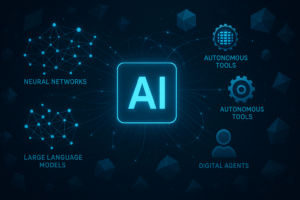
Artificial Intelligence (AI) tools are software platforms or libraries that utilize machine learning (ML), natural language processing (NLP), computer vision, or generative AI to automate tasks, analyze data, or simulate human cognitive functions. Unlike traditional algorithms, these tools adapt through continuous learning, enabling:
1. Predictive Analytics: Forecast trends using historical data (e.g., Salesforce Einstein).
2. Process Automation: Streamline workflows via robotic process automation (RPA) tools like UiPath.
3. Creative Generation: Produce text, images, or code with models like GPT-4 or Midjourney.
4. Cognitive Services: Enhance apps with Azure’s speech recognition or AWS Rekognition.
Modern AI tools operate across cloud, edge, and hybrid environments, integrating data from IoT devices, CRM systems, and APIs. Their evolution—from rule-based systems to transformer-based neural networks—enables real-time responses, contextual awareness, and self-optimization.
TOOLS / SYSTEM REQUIREMENTS
To deploy AI tools, consider these technical prerequisites:
– TensorFlow/PyTorch (deep learning)
– SpaCy/NLTK (NLP)
– OpenCV (computer vision)
Cloud Platforms:
– AWS SageMaker (model deployment)
– Google AI Platform (AutoML)
– Microsoft Azure ML (MLOps pipelines)
Hardware:
– GPUs (NVIDIA A100 for training)
– TPUs for cloud-based inference
– Edge devices (Jetson Nano for IoT deployments)
WORKFLOW & IMPLEMENTATION GUIDE 
STEP 1: Data Preparation
– Clean datasets using Pandas; normalize with Scikit-learn.
– Store structured/unstructured data in Snowflake or AWS S3.
Pro Tip: Augment data with GANs to address imbalances.
STEP 2: Model Selection
– Use Hugging Face Transformers for NLP tasks.
– Deploy vision models via MMDetection or YOLOv8.
STEP 3: Training & Validation
– Train models on Kaggle Kernels or Google Colab.
– Validate using k-fold cross-validation.
STEP 4: Deployment
– Containerize models with Docker; orchestrate via Kubernetes.
– Serve APIs using FastAPI or Flask.
STEP 5: Monitoring
– Track drift with Evidently AI; retrain models via MLflow.
For complex artificial intelligence tools use cases, integrate reinforcement learning for adaptive systems or federated learning for privacy compliance.
BENEFITS & TECHNICAL ADVANTAGES
AI tools deliver measurable ROI:
– 300% Faster Processing: Automate document analysis via NLP.
– 40% Cost Reduction: Predictive maintenance in manufacturing.
– 99% Accuracy: Fraud detection in finance using anomaly detection.
– Scalability: Serve millions of users via cloud-native architectures.
ADVANCED USE CASES & OPTIMIZATION TIPS
1. Healthcare: Diagnose anomalies in X-rays using MONAI.
2. Retail: Optimize prices dynamically with Prophet.
3. Cybersecurity: Detect zero-day threats via Darktrace’s AI.
Optimization Tactics:
– Quantize models with TensorRT for 4x inference speed.
– Fine-tune LLMs using LoRA adapters.
COMMON ISSUES & TROUBLESHOOTING

Problem 1: Overfitting
– Fix: Apply dropout layers or L2 regularization.
Problem 2: API Latency
– Fix: Use AWS Lambda for serverless inference.
Problem 3: GPU Memory Errors
– Fix: Reduce batch size; leverage gradient checkpointing.
SECURITY & MAINTENANCE
Security Protocols:
– Encrypt data in transit/in rest (TLS 1.3, AES-256).
– Audit models with Robust Intelligence.
Maintenance:
– Update dependencies via Dependabot.
– Conduct A/B testing for model iterations.
CONCLUSION
Artificial intelligence tools are no longer optional—they’re critical for sustaining innovation in data-driven markets. From automating customer service with NLP to optimizing supply chains via predictive analytics, their artificial intelligence tools use cases span industries and scales. Start small: prototype a chatbot using Dialogflow, then expand to mission-critical systems.
As AI evolves, staying current with artificial intelligence tools reviews will ensure you leverage cutting-edge capabilities. Ready to transform your operations? Identify one workflow to automate this week.
FAQs
Q1: Which AI tools integrate with legacy Java systems?
A: Use Apache Mahout or Deeplearning4j for JVM compatibility.
Q2: How to reduce AI model bias?
A: Apply fairness metrics like AI Fairness 360; diversify training data.
Q3: Can AI tools run offline?
A: Yes—deploy lightweight models via TensorFlow Lite or ONNX Runtime.
Q4: What’s the cost of enterprise AI deployment?
A: From $10K/year (cloud APIs) to $500K+ (custom MLOps pipelines).
Q5: How to secure generative AI outputs?
A: Implement content filters and audit logs via Azure Content Safety.
Share this content:










Post Comment