Smarter Hiring With the Latest AI Recruitment Tools
AI Recruitment Tools: The Trends Transforming Hiring in 2025
Key Takeaways
-
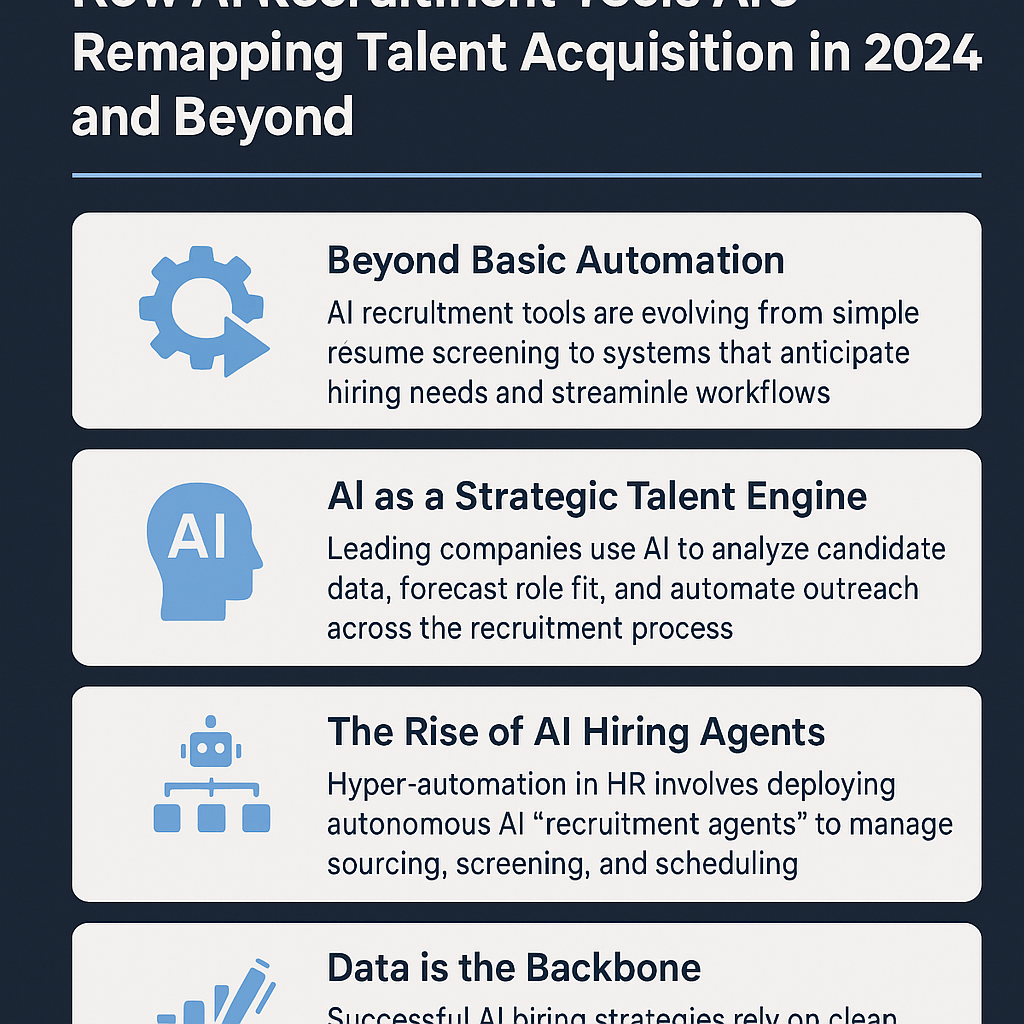
Beyond Basic Automation: AI recruitment tools are evolving from simple résumé screening to advanced predictive, generative, and autonomous systems that anticipate hiring needs and streamline full recruitment workflows.
-
AI as a Strategic Talent Engine: Leading companies now use AI to analyze candidate data, forecast role fit, generate job descriptions, automate outreach, and even simulate candidate performance using synthetic datasets.
-
The Rise of AI Hiring Agents: Hyper-automation in HR means deploying autonomous AI “recruitment agents” capable of managing multi-step tasks like sourcing, pre-screening, scheduling, and pipeline nurturing without human intervention.
-
Data is the Backbone: Successful AI hiring strategies rely on clean, structured talent data. High-quality data ensures more accurate predictions, better match scoring, and stronger hiring decisions.
Imagine a recruitment map—not one that charts geography, but a dynamic landscape of candidate potential, hiring timelines, and evolving workforce needs. Instead of physical landmarks, it visualizes emerging skills, job market shifts, applicant behavior patterns, and predicted role matches.
This isn’t speculative fiction—it’s a powerful metaphor for the new direction of AI recruitment tools. The hiring process is undergoing a profound transformation, moving far beyond simple automation to end-to-end intelligent systems capable of predicting candidate success, optimizing workflows, and reimagining the very architecture of talent acquisition.
Just a year ago, conversations around AI in HR focused mostly on résumé screening or chatbots. Today, the leading edge of AI recruitment reaches much deeper. Businesses are adopting advanced tools that not only process applications but uncover hidden talent, eliminate bottlenecks, and forecast hiring outcomes with remarkable accuracy.
We are entering an era where AI doesn’t just assist hiring—it actively drives it.
Modern AI recruitment tools can:
-
Analyze candidate skills across structured and unstructured data
-
Predict cultural and performance fit
-
Automate personalized outreach at scale
-
Build dynamic talent pools
-
Recommend role adjustments based on emerging workforce trends
-
Identify inefficiencies in the hiring pipeline through process mining
This new landscape demands a new level of strategic thinking. For HR leaders, recruiters, and business executives, understanding how these tools function—and how to deploy them effectively—is no longer optional. It is essential for staying competitive in a market where speed, accuracy, and talent visibility define success.
At AITechScope, we help organizations decode this new recruitment cartography and apply the latest AI innovations to build smarter, faster, and more equitable hiring systems. With the right tools and guidance, businesses can elevate their recruitment strategies and unlock a new era of data-driven talent acquisition.
The Top AI Trends and Tools Reshaping the Business Landscape
To thrive in this evolving environment, it’s crucial to look beyond the hype and focus on the practical applications that drive real-world value. The most significant AI trends and tools are not isolated novelties; they are interconnected components of a larger digital transformation engine. Here’s a detailed look at the key developments you need to have on your radar.
1. The New Cartography: AI in Predictive Analytics and Forecasting
The ability to accurately predict the future has always been the holy grail of business strategy. AI-powered predictive analytics is bringing us closer than ever to that goal. This trend is about shifting from a reactive posture—analyzing past performance—to a proactive one where decisions are guided by data-driven forecasts.
How it Works: Predictive models use machine learning algorithms to analyze vast historical datasets, identify subtle patterns and correlations, and project future outcomes. Think of it as an AI-powered meteorologist for your business, forecasting not weather, but customer demand, supply chain disruptions, employee turnover, and market fluctuations.
Practical Business Applications:
- Inventory and Supply Chain Management: Retailers and manufacturers can predict product demand with remarkable accuracy, optimizing stock levels to prevent overstocking or stockouts. AI can model the impact of seasonality, marketing campaigns, and even global events on the supply chain, suggesting proactive adjustments.
- Customer Churn Prediction: By analyzing customer behavior, engagement metrics, and support interactions, AI can identify customers at high risk of leaving. This allows businesses to intervene with targeted retention offers or improved service, saving valuable revenue.
- Financial Forecasting: AI models can analyze market data, economic indicators, and internal financial records to create more dynamic and accurate revenue and cash flow projections, enabling smarter budgeting and investment decisions.
The AITechScope Advantage: Implementing predictive analytics requires more than just software; it requires a strategic approach. Our AI consulting services help you identify the most valuable prediction opportunities within your business. We then leverage powerful automation platforms like n8n to build workflows that not only gather and process the necessary data but also trigger actions based on the AI’s predictions—for example, automatically launching a retention campaign when a customer is flagged as a churn risk.
2. Generative AI’s Next Frontier: Beyond Text and Images
While tools like ChatGPT and Midjourney brought generative AI into the mainstream, the next wave is about generating far more than just content. The new frontier is the generation of complex, functional outputs like code, business strategies, and optimized process models.
How it Works: Advanced generative models are being trained on diverse datasets that include programming languages, business process diagrams, and strategic frameworks. This allows them to understand context and intent, generating outputs that are not only creative but also logical and actionable.
Practical Business Applications:
- Accelerated Software and Website Development: AI tools can now generate entire blocks of functional code, APIs, and even user interface designs from natural language prompts. This dramatically speeds up development cycles and lowers the barrier to entry for creating custom digital solutions.
- Automated Strategy Formulation: Businesses can feed an AI model market research, competitor data, and internal performance metrics to have it generate potential marketing campaign strategies, product launch plans, or operational improvement initiatives. While human oversight is crucial, this provides a powerful brainstorming and decision-support tool.
- Synthetic Data Generation: For industries like finance and healthcare, privacy regulations can make it difficult to train AI models on real customer data. Generative AI can create large volumes of realistic, anonymized “synthetic” data that mirrors the statistical properties of the real data, enabling model development without compromising privacy.
The AITechScope Advantage: This is where our expertise in website development and automation converges. We use generative AI tools to accelerate the creation of custom web solutions and applications for our clients. More importantly, we integrate this capability into your daily operations. Using n8n, we can build a workflow where a project manager can describe a new marketing landing page in plain English, and an AI will generate the initial HTML and CSS, which is then automatically deployed to a staging server for review—turning a multi-day task into a matter of minutes.
3. Hyper-Automation and AI Agents: Your Autonomous Workforce
If automation was about teaching a robot to do one task repeatedly, hyper-automation is about creating a system of intelligent “AI agents” that can collaborate to manage entire complex processes from end to end. These autonomous agents are designed to handle multi-step tasks that require reasoning, decision-making, and interaction with various digital tools.
How it Works: An AI agent is given a high-level objective (e.g., “Find the top five potential sales leads in the manufacturing sector in Ohio, enrich their data, and draft personalized outreach emails”). The agent then breaks this goal down into a series of sub-tasks: searching LinkedIn, querying a database like Crunchbase, visiting company websites to find contact information, and using a generative AI to write the emails. It executes these tasks autonomously, learning and adapting as it goes.
Practical Business Applications:
- Intelligent Lead Generation and Sales Outreach: An AI agent can manage the entire top-of-funnel sales process, from market research to initial contact, freeing up human sales teams to focus on building relationships and closing deals.
- Autonomous Project Management: Agents can monitor project progress, track deadlines, send reminders to team members, reallocate resources based on delays, and generate status reports for stakeholders, acting as a tireless virtual project coordinator.
- Complex Customer Support Resolution: When a complex support ticket arrives, an AI agent can investigate the issue by querying internal databases, reviewing past customer interactions, and even running diagnostics before either resolving the issue or escalating it to a human agent with a complete summary of its findings.
The AITechScope Advantage: This trend is at the absolute core of what we do. n8n is the perfect platform for building and orchestrating these AI agents. We design robust n8n workflows that serve as the “central nervous system” for your autonomous workforce. Our expert virtual assistants don’t just perform manual tasks; they manage, monitor, and refine these AI-powered automation systems, ensuring they run flawlessly. We help you delegate not just tasks, but entire outcomes to an intelligent, automated system that we build and maintain for you.
4. AI-Powered Process Mining: Mapping Your Internal Universe
You can’t optimize what you can’t see. Many businesses operate on assumptions about how their internal processes work, but the reality is often far more complex and inefficient. AI-powered process mining acts like an MRI for your organization, creating a detailed, data-driven map of your actual workflows.
How it Works: Process mining tools analyze the digital footprints left in your company’s software systems (e.g., timestamps in your CRM, ERP, or project management tools). By piecing together these “event logs,” the AI can visualize exactly how processes like order-to-cash, customer onboarding, or procurement are being executed in the real world, instantly highlighting bottlenecks, redundant steps, and compliance deviations.
Practical Business Applications:
- Workflow Optimization: A company might discover that its invoice approval process, which should take two days, is frequently delayed for weeks because invoices are stuck waiting for a specific manager’s approval. With this insight, they can automate the approval routing.
- Compliance and Audit: In regulated industries, process mining can automatically verify that required procedures are being followed, providing a continuous audit trail and flagging any deviations from compliance protocols.
- Enhancing Customer Experience: By mapping the customer journey from first contact to post-purchase support, businesses can identify points of friction and delay, allowing them to streamline the experience and increase satisfaction.
The AITechScope Advantage: Our business process optimization consulting begins with principles of process mining. We help you uncover these hidden inefficiencies. Once we’ve mapped the “as-is” process and identified opportunities, we use n8n to build the optimized “to-be” process. We can automate the bottlenecks away, create intelligent approval workflows, and integrate disparate systems to ensure data flows seamlessly, transforming your operations from the inside out.
Practical Takeaways: How to Start Charting Your AI Course
Seeing these trends is one thing; acting on them is another. Here’s how you can begin leveraging these powerful AI trends and tools in your own business:
- Start with an Audit, Not a Tool: Don’t chase the shiniest new AI tool. Instead, start by identifying a specific, high-friction, and high-value process in your business. Is it lead qualification? Is it employee onboarding? Find the pain point first, then seek the AI solution.
- Prioritize Data Hygiene: AI models are only as good as the data they are trained on. Before embarking on a major AI initiative, invest time in cleaning, organizing, and standardizing your data. A well-organized CRM is more valuable than the most advanced AI.
- Foster a Culture of Experimentation: Encourage your team to experiment with small-scale AI tools and automations. Create a safe environment to test, fail, and learn. The biggest barrier to AI adoption is often cultural inertia, not technical limitations.
- Partner with an Expert Navigator: The AI landscape is vast and complex. Partnering with a specialist like AITechScope allows you to leverage expert knowledge without the steep learning curve. We can help you identify the right opportunities, select the best tools, and implement solutions that deliver a clear ROI.
Conclusion: AITechScope is Your Guide to the New Business Map
The latest AI trends and tools are doing more than just improving existing processes—they are offering us entirely new ways to visualize, understand, and operate our businesses. They are the new maps and compasses for navigating the complexities of the digital economy. From predicting future market demands and generating intelligent strategies to deploying autonomous agents that manage entire workflows, the potential to enhance efficiency, drive growth, and create a sustainable competitive advantage is immense.
But a map is only useful if you have a skilled navigator to help you read it.
At AITechScope, we are those navigators. Our unique blend of AI consulting, expert n8n automation development, and hands-on management through our virtual assistant services provides an end-to-end solution for businesses ready to embrace the future. We don’t just talk about trends; we build the practical, customized systems that put these trends to work for you.
Ready to chart your course for growth and efficiency? Schedule a Free AI Automation Consultation with AITechScope Today!
Additional Frequently Asked Questions
Q: How do AI recruitment tools improve the quality of hires?
A: AI recruitment tools analyze far more data points than a human recruiter can—skills, behavior patterns, experience relevance, cultural alignment, and even predicted performance. By removing guesswork and bias-prone intuition, AI helps companies shortlist better-fit candidates with higher accuracy.
Q: Can AI recruitment tools eliminate bias in hiring?
A: AI can significantly reduce bias by focusing on objective data rather than subjective human judgment. However, the key is to train AI models on clean, balanced datasets. When properly set up, AI becomes a powerful ally for fair, equitable hiring.
Q: Do AI hiring agents replace human recruiters?
A: No. AI agents enhance the recruiter’s capabilities by handling repetitive tasks—sourcing, screening, scheduling—so humans can focus on interviews, relationship-building, and final decision-making. Think of AI as a “digital assistant,” not a replacement.
Q: Are AI recruitment tools difficult to integrate with existing HR systems?
A: Most modern AI hiring tools offer plug-and-play integrations with Applicant Tracking Systems (ATS), job boards, calendars, CRMs, and communication platforms. Platforms like n8n make it even easier by automating connections between systems without heavy engineering.
Q: What types of businesses benefit most from AI recruitment tools?
A: Fast-growing companies, agencies, and organizations with high-volume hiring needs see the biggest gains. However, small businesses benefit too—AI can help them compete with larger companies by automating sourcing and improving candidate insights.
Q: How do AI tools enhance candidate experience?
A: AI enables faster response times, personalized communication, automated scheduling, and real-time updates. This creates a smoother, more engaging applicant journey—reducing drop-offs and improving employer branding.
Q: What is predictive analytics in recruitment?
A: Predictive analytics uses historical and real-time data to forecast key outcomes—such as which candidates are most likely to succeed, how long a role will take to fill, or which channels deliver the strongest applicants. This helps HR teams make smarter, data-backed decisions.
Q: Can AI recruitment tools generate job descriptions?
A: Yes. AI can analyze skills, responsibilities, performance data, and industry trends to automatically create optimized, inclusive job descriptions tailored to attract the right candidates and improve search visibility on job boards.
Q: How secure is candidate data when using AI platforms?
A: Reputable AI recruitment tools comply with GDPR, SOC 2, CCPA, and industry-leading security standards. AITechScope ensures all workflows are built with encrypted data handling, strict access controls, and ethical AI practices.
Q: How does AITechScope support companies adopting AI recruitment tools?
A: AITechScope provides end-to-end implementation—tool selection, workflow design, n8n orchestration, AI agent integration, data preparation, and ongoing optimization. We act as both your strategist and technical execution partner to ensure measurable results.
Share this content: