Top AI Trends and Tools for Business Growth in 2025
Navigating the Next Wave: The Top AI Trends and AI-powered tools for business growth
Key Takeaways
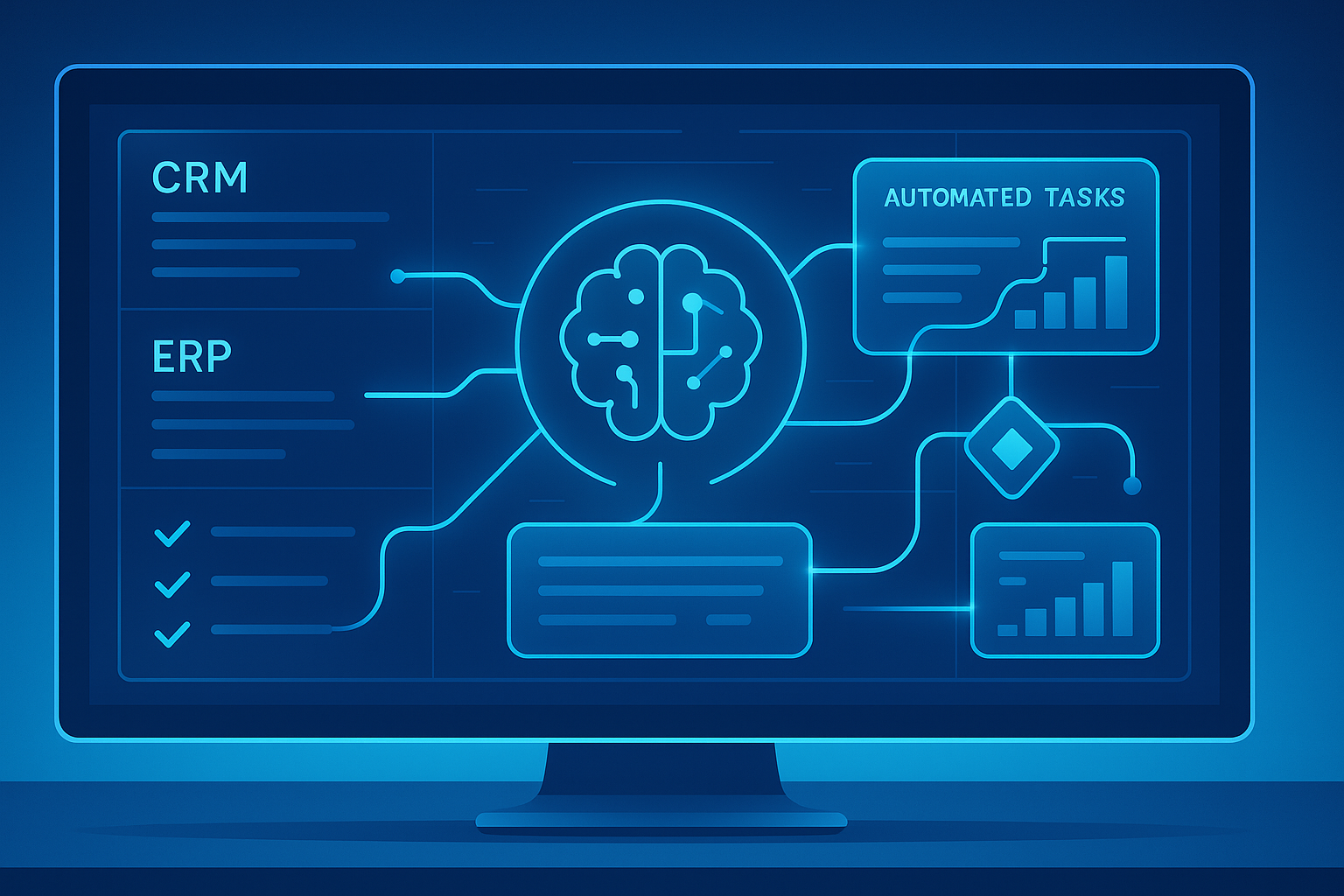
- Deep Integration Over Standalone Tools: The primary shift in AI is its embedding directly into core business software (CRMs, ERPs), making it a seamless, contextual assistant rather than a separate application.
- The Rise of Hyper-automation: Beyond simple task automation, AI is now orchestrating complex, multi-step workflows, acting as a decision-making “brain” that connects various applications to handle processes like lead qualification and personalization end-to-end.
- Content Creation Reimagined with Multimodal AI: AI models can now process and generate content across text, image, and video formats simultaneously, allowing businesses to repurpose a single piece of content into dozens of assets with minimal effort.
- From Passive Assistants to Autonomous Agents: The future is AI agents—proactive systems that can be given complex, high-level goals (like competitor monitoring or meeting organization) and can autonomously use various tools to achieve them.
The world of artificial intelligence is no longer moving in years or even months; it’s evolving in weeks. What was once a futuristic concept discussed in boardrooms is now a tangible, operational reality reshaping industries from the ground up. For business professionals, entrepreneurs, and forward-thinking leaders, staying ahead of the curve isn’t just an advantage—it’s a necessity. Understanding the most impactful AI trends and tools is the first step toward unlocking unprecedented efficiency, innovation, and growth. As we move deeper into this transformative era, the question is no longer if you should adopt AI, but how you can integrate it intelligently to build a more resilient, scalable, and profitable business.
At AITechScope, we live and breathe this evolution. We see firsthand how intelligent automation and strategic AI implementation are creating a new paradigm for operational excellence. This isn’t about chasing shiny objects; it’s about fundamentally rethinking workflows, delegating complex tasks to intelligent systems, and freeing up your human talent to focus on what they do best: strategy, creativity, and building relationships. This guide will cut through the noise, synthesizing the most critical AI developments into a clear, actionable roadmap for your business.
The New Business Imperative: Understanding Today’s Top AI Trends and Tools
The current AI landscape is characterized by a significant shift from standalone, task-specific tools to deeply integrated, multi-functional platforms. AI is becoming the central nervous system of modern business operations, capable of understanding context, making decisions, and executing multi-step processes autonomously. For leaders, this means moving beyond simple chatbots or content generators and envisioning AI as a core strategic asset. Let’s explore the four pivotal trends that are defining this new chapter and the practical ways you can begin to leverage them.

Trend 1: From Prompt to Production: Generative AI’s Deep Integration into Business Operations
Generative AI, powered by Large Language Models (LLMs), has captured the public imagination. However, its true business value lies far beyond writing emails or generating images on command. The latest evolution is the deep embedding of this technology into core business software and internal workflows, making it an ambient, ever-present assistant.
What It Is: Instead of employees switching between their primary work application and a separate AI tool, generative AI capabilities are now being built directly into CRMs, ERPs, project management software, and communication platforms. This creates a seamless experience where AI assistance is contextual and proactive.
Real-World Business Applications:
- Sales & Marketing Automation: Imagine a CRM that doesn’t just store customer data but also analyzes recent interactions and automatically drafts personalized follow-up emails in your brand’s voice. Marketing platforms can now generate entire campaigns—from ad copy and social media posts to landing page text and email sequences—based on a single product brief.
- Internal Knowledge Management: Companies are building custom, internal AI models trained on their own documentation, past projects, and support tickets. This creates a “company brain” that any employee can query in natural language. Instead of searching through folders, a project manager can ask, “What were the key takeaways from our Q3 launch last year?” and receive a concise, accurate summary with links to source documents.
- AI-Assisted Development: Software developers are using AI tools that function as co-pilots, suggesting code, identifying bugs in real-time, and even generating entire functional modules from a simple description. This dramatically accelerates development cycles and reduces time spent on repetitive coding tasks.
Practical Takeaway for Your Business:
Start by auditing your most time-consuming, content-centric tasks. Is your team spending hours summarizing meeting notes, writing monthly reports, or creating initial drafts for proposals? These are prime candidates for automation. Pilot a tool like a custom GPT or an AI-integrated project management system with a small team. Measure the time saved and the quality of the output to build a business case for wider adoption.
How AITechScope Helps: Strategic integration is key. We go beyond recommending off-the-shelf tools. Our AI consulting services help you identify the highest-impact areas for generative AI within your specific operations. We then design and implement custom solutions, such as internal knowledge bots or automated content pipelines, ensuring the technology serves your unique business goals.
Trend 2: The Rise of Hyper-automation: How AI is the Brain of Your Workflow
Standard automation, which follows simple “if this, then that” rules, has been around for years. Hyper-automation is its intelligent successor. It’s a business-driven approach to rapidly identify, vet, and automate as many processes as possible using a combination of tools, including AI, machine learning, and robotic process automation (RPA). Here, AI is not just a step in the process; it’s the decision-making engine that orchestrates the entire workflow.
What It Is: Hyper-automation involves creating sophisticated, multi-step workflows that connect various applications and leverage AI to handle variability and make judgments that were once exclusively human. It’s about creating resilient, end-to-end automated systems that can adapt and learn.
Example of an AI-Powered Hyper-automation Workflow:
- Lead Ingestion: A potential client fills out a contact form on your website.
- AI Enrichment: The system automatically uses AI to research the lead’s company, industry, and size from public data sources like LinkedIn.
- AI Qualification & Routing: Based on this enriched data, an AI model scores the lead’s potential value and determines the best sales representative to handle it based on territory or industry expertise.
- Automated Personalization: The workflow then triggers a generative AI to draft a highly personalized outreach email, referencing the lead’s specific industry and potential pain points.
- Task Management: The draft email is sent to the assigned sales rep for a final one-click approval, and a follow-up task is automatically scheduled in the company CRM.
This entire process happens in seconds, ensuring every lead is handled instantly, consistently, and with a level of personalization that would be impossible to scale manually.
Practical Takeaway for Your Business:
Whiteboard a critical business process, like client onboarding or invoice processing. Document every single step, decision point, and manual data entry required. You’ll likely discover numerous bottlenecks and opportunities for intelligent automation. Start with one component, such as automatically categorizing incoming support tickets using AI, before building out the full end-to-end workflow.
How AITechScope Helps: This is our specialty. We are experts in n8n, a powerful, flexible workflow automation platform that is perfect for building these complex hyper-automation systems. Unlike more restrictive platforms, n8n allows us to connect virtually any application or AI model, creating truly bespoke solutions. We design, build, and manage these intricate workflows, turning your fragmented processes into a seamless, intelligent, and autonomous operational machine.
Trend 3: The Multimodal Revolution: When Text, Image, and Voice AI Converge
The most advanced AI models are no longer limited to a single type of data. Multimodal AI can understand, process, and generate content across various formats—text, images, audio, and video. This convergence is breaking down silos between different types of media and unlocking powerful new capabilities for businesses.
What It Is: A multimodal AI can, for instance, watch a video, generate a text summary, transcribe the audio, identify key objects or people in the frames, and even create a short promotional clip from the most engaging moments. It processes information holistically, much like a human does.
Real-World Business Applications:
- Content Repurposing on Steroids: A marketing team can upload a one-hour webinar recording. A multimodal AI can then generate a full transcript, write a 1,500-word blog post based on the content, create five key takeaway graphics for social media, produce a 60-second video clip for TikTok, and draft an email newsletter summarizing the event. This multiplies the ROI on a single piece of content.
- Enhanced Customer Support: AI can analyze customer support calls, transcribing the audio while simultaneously analyzing the speaker’s tone of voice for sentiment (e.g., frustration, satisfaction). This provides managers with deep insights into customer experience and agent performance without having to listen to hours of calls.
- Intelligent Product Design: Engineers and designers can provide a sketch of a product (image) along with a text description of its features. The AI can then generate realistic 3D models, suggest material improvements, and even create marketing copy for the product website.
Practical Takeaway for Your Business:
Review your content creation strategy. Are you manually and painstakingly adapting your content for different platforms? Explore multimodal tools that can automate this repurposing. Consider a pilot project where you take one major piece of content and use AI to transform it into at least three other formats. This can dramatically increase your marketing reach with minimal additional effort.
How AITechScope Helps: An effective multimodal strategy requires a strong digital foundation. AITechScope’s website development services ensure you have a robust, modern platform to host and deliver this rich, AI-generated content. Furthermore, our automation experts can build the workflows that connect these multimodal tools, creating a content engine that runs on autopilot, from initial generation to final publication on your website and social channels.
Trend 4: The Dawn of AI Agents: Your New Autonomous Workforce
If LLMs are the engine, AI agents are the entire vehicle. An AI agent is an autonomous system that can perceive its environment, make decisions, and take actions to achieve a specific, complex goal. They can operate independently over long periods, use different tools (like browsing the web or accessing a database), and even self-correct when they encounter obstacles. This is the evolution of the virtual assistant from a passive tool to a proactive team member.
What It Is: You don’t just give an agent a single prompt; you give it a high-level objective. For example, instead of asking it to “write an email to John,” you could task it with: “Organize a meeting with the marketing team to discuss the Q4 budget. Find a time that works for everyone, book a conference room, create a draft agenda based on last quarter’s meeting notes, and send out the calendar invitation.”
Real-World Business Applications:
- Autonomous Research & Analysis: An executive could deploy an AI agent to “monitor our top three competitors’ online activity this week and produce a summary report on Friday highlighting any new product launches, marketing campaigns, or significant press mentions.” The agent would autonomously browse websites, news articles, and social media to complete the task.
- Proactive Project Management: An AI agent integrated into a project management tool could monitor project progress, identify potential delays based on task dependencies, and proactively nudge team members who are falling behind on their deadlines.
- Supply Chain & Inventory Management: An agent could be tasked with monitoring inventory levels, tracking supplier shipping times, and analyzing sales forecasts. When inventory for a popular product dips below a certain threshold, the agent could automatically generate and place a purchase order with the most cost-effective supplier.
Practical Takeaway for Your Business:
Start thinking in terms of outcomes, not tasks. Identify a complex, multi-step objective you regularly delegate to a human assistant. Break down the process into its component steps and the tools required for each. This thought exercise will prepare you for a future where you can delegate the entire outcome to an AI agent.
How AITechScope Helps: This is the pinnacle of intelligent delegation and the core of our mission. We are at the forefront of designing and deploying these AI-powered virtual assistants. We build the systems that allow these agents to securely access the tools and information they need, and our human-in-the-loop virtual assistant services provide the critical oversight, quality control, and strategic direction to ensure these agents are performing effectively and aligning with your business goals. We bridge the gap between the raw potential of AI agents and their practical, reliable application in your business.
How AITechScope Turns AI Trends into Business Reality
Reading about these trends is one thing; implementing them is another. The path to successful AI integration is paved with strategic planning, technical expertise, and a deep understanding of business processes. That’s where AITechScope becomes your indispensable partner.
We don’t just follow the trends; we build practical solutions around them.
- AI Consulting: Our process begins with understanding your unique challenges and goals. We help you cut through the hype and develop a pragmatic AI strategy, identifying the tools and workflows that will deliver the highest return on investment.
- n8n Automation: We are experts in building the robust, scalable automation backbones that power modern businesses. Whether it’s a simple two-app connection or a complex, AI-driven hyper-automation workflow, our n8n development brings your vision to life.
- AI-Powered Virtual Assistants: We combine the power of autonomous AI agents with the reliability of human oversight. We build, manage, and refine these systems, providing you with a new class of assistant that can handle complex, end-to-end business processes.
- Website Development: Your digital presence is the stage where many of these AI-powered experiences play out. We build fast, secure, and scalable websites that are ready to integrate with AI-driven personalization, intelligent chatbots, and automated content delivery systems.
Don’t Just Watch the Future Unfold—Build It
The AI revolution is here, and it’s accelerating. The businesses that thrive will be those that move from passive observation to active implementation. By embracing these AI trends and tools, you can not only optimize your current operations but also unlock entirely new models for growth and innovation. The key is to start now, with a clear strategy and an expert partner to guide you.
Ready to harness the power of these AI trends and tools for your business? Don’t just read about the future—build it.
Schedule a free consultation with an AITechScope AI strategist today and discover how our custom automation and consulting services can transform your operations.
Frequently Asked Questions (FAQ)
1. What is the real difference between standard automation and hyper-automation?
Standard automation typically follows simple, predefined “if-then” rules (e.g., “IF a new email arrives, THEN create a task”). Hyper-automation is an evolution where AI acts as the decision-making engine for the entire workflow. It can handle variability, enrich data, make judgments (like scoring a lead’s potential), and orchestrate complex, multi-step processes across several different applications, making the automation far more intelligent and resilient.
2. How can a small business start using AI without a huge budget?
The key is to start small and focus on high-impact areas. Begin by auditing your team’s most time-consuming manual tasks, especially those involving content creation, data entry, or summarizing information. Pilot a low-cost generative AI tool or an integrated application for a specific task (like summarizing meeting notes). By measuring the time saved, you can build a strong business case for further, more strategic investment in AI.
3. What is an ‘AI Agent’ and how is it different from a chatbot like ChatGPT?
A chatbot is a reactive tool; it responds to your prompts. An AI agent is a proactive, autonomous system. You don’t give it a single prompt; you give it a complex, high-level goal. The agent can then independently use various tools (like browsing the web, accessing a CRM, or sending emails) and self-correct its actions over time to achieve that goal. Think of it as delegating an entire outcome to a virtual team member, not just asking a single question.
4. Is multimodal AI just for large marketing teams?
Not at all. While large teams benefit greatly, multimodal AI is a powerful efficiency-booster for any business creating content. A solo entrepreneur or small business can turn a single video, podcast, or presentation into a blog post, multiple social media updates, and an email newsletter in a fraction of the time it would take manually. This allows smaller operations to multiply their marketing reach and get a much higher return on their content creation efforts.
“`
Share this content: