Ai investigator 9 Best tips for fraud detection and compliance
AI Investigator: 9 Best Tips for Fraud Detection
Meta Description: Unlock the power of an AI investigator for fraud detection. This guide reveals 9 essential tips on risk analytics, machine learning models, and automation to strengthen your compliance framework and reduce financial losses.
Introduction: Why Aren’t We Winning the War on Fraud?
Did you know that according to the Association of Certified Fraud Examiners (ACFE), organisations lose a staggering 5% of their annual revenue to fraud? In an increasingly digital world, traditional rule-based systems are no longer enough to combat sophisticated, evolving threats. It’s a high-stakes game where bad actors leverage AI, forcing businesses to fight fire with fire. This is where the role of an AI investigator becomes critical. By harnessing machine learning and advanced analytics, an AI investigator doesn’t just find fraud; it predicts and prevents it, transforming your compliance posture from reactive to resilient. This guide will walk you through nine actionable tips to effectively implement and leverage an AI investigator for superior fraud detection and compliance.
The Core Frameworks of a Modern AI Investigator
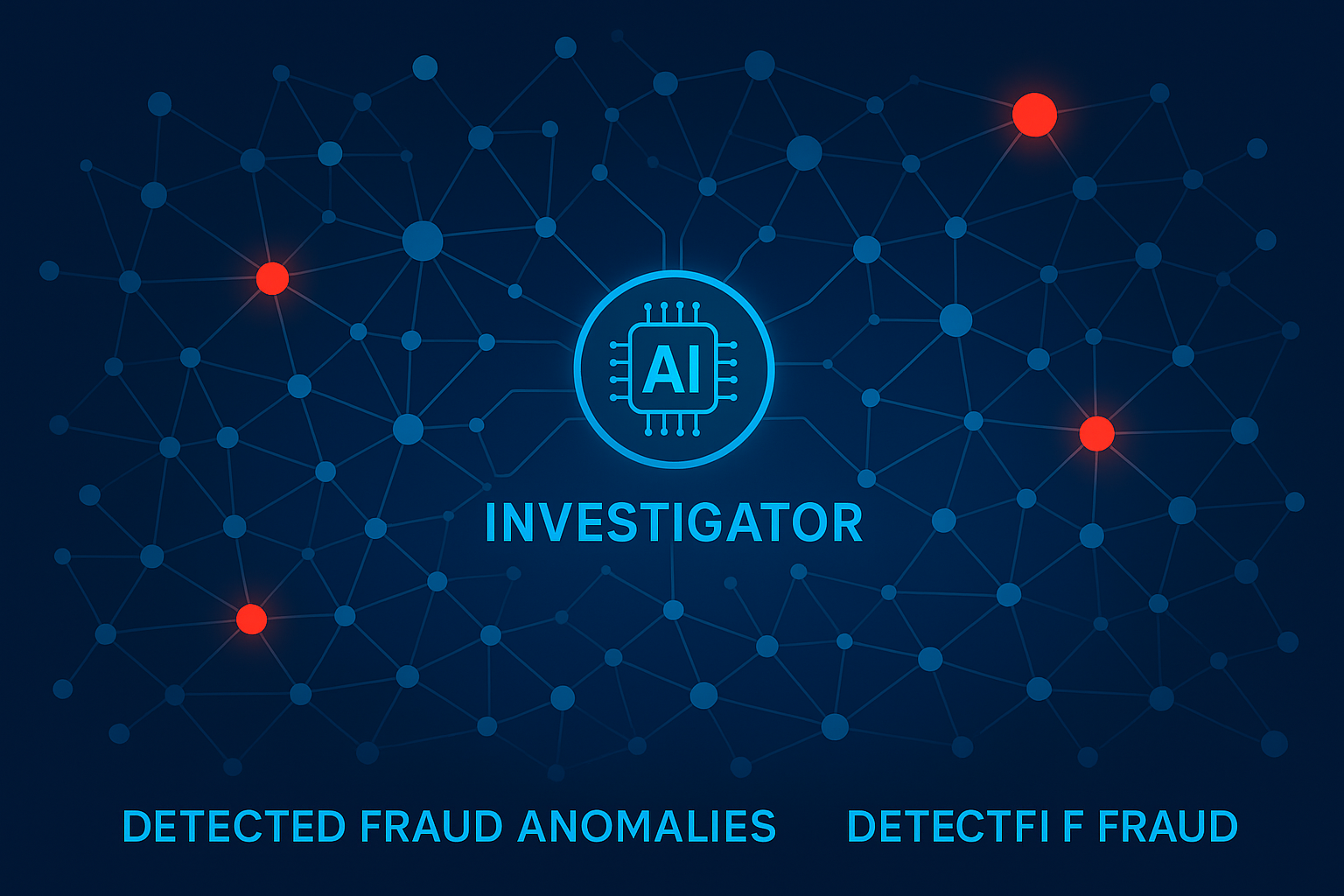
An AI investigator isn’t a single tool but a sophisticated system built on interconnected technologies. Understanding these core components is the first step to building a robust AI Investigator:
- Machine Learning (ML) Models: The core engine. These include supervised learning (for classifying known fraud patterns) and unsupervised learning (for detecting novel, unknown anomalies).
- Natural Language Processing (NLP): Analyses unstructured data like emails, customer chats, and transaction narratives to uncover subtle, text-based fraud signals.
- Network Analysis: Maps relationships and interactions between entities (e.g., users, accounts, IP addresses) to uncover complex collusion rings and organised fraud.
- Behavioural Biometrics & Analytics: Establishes a baseline of normal user behaviour (typing speed, mouse movements, transaction habits) and flags significant deviations in real-time.
- Predictive Analytics: Uses historical data to forecast future fraud risk scores for transactions, accounts, or applicants, enabling proactive intervention.
The Evolution of AI in Fraud Detection: A Realistic Timeline
The integration of AI into security isn’t an overnight switch; it’s a strategic evolution. Here’s how a typical adoption roadmap looks for an enterprise leveraging an AI investigator.
| Phase | Timeline | Key Activities & Projections |
|---|---|---|
| Foundation & Piloting | Short-Term (0-6 Months) | Integrate basic ML models with existing systems. Focus on a single use case (e.g., payment fraud). By 2025, over 80% of major financial institutions will have completed this phase. |
| Expansion & Integration | Mid-Term (6-18 Months) | Scale the AI investigator across multiple channels (e-commerce, mobile, in-branch). Implement network analysis and NLP. Achieve a 30-50% reduction in false positives. |
| Maturation & Autonomy | Long-Term (18+ Months) | Achieve a fully autonomous fraud defence. Systems self-learn and adapt in real time. Predictive models prevent >90% of attempted fraud before financial loss occurs. |
9 Essential Steps to Implement Your AI Investigator
Here is a step-by-step guide to building and deploying a powerful AI investigation framework.
Step 1: Conduct a Comprehensive Risk Assessment
Before writing a single line of code, you must identify your crown jewels. Where is your organisation most vulnerable? Is it credit card applications, claims processing, or employee expense reports? A targeted assessment ensures your AI investigator is deployed where it will have the most significant impact.
Step 2: Aggregate and Cleanse Your Data
An AI investigator is only as good as the data it’s fed. Consolidate data from all relevant sources: transactional databases, CRM systems, web logs, and third-party threat intelligence feeds. Garbage in, garbage out—data cleansing is a non-negotiable first step.
Step 3: Select the Right Machine Learning Models
Don’t fall for the one-size-fits-all approach. For known fraud patterns, use supervised models like Random Forest or Gradient Boosting. To uncover “unknown unknowns”, implement unsupervised learning algorithms like Isolation Forests or Autoencoders to detect anomalous behaviour that doesn’t match any prior label.
Step 4: Integrate with Real-Time Processing Engines
Batch processing is too slow for modern fraud. Your AI investigator must be integrated with real-time data streams using platforms like Apache Kafka or cloud-native services to analyse and score transactions in milliseconds, blocking fraud at the point of attempt.
Step 5: Establish a Human-in-the-Loop (HITL) Framework
AI is not here to replace your fraud analysts but to empower them. Implement a HITL system where the AI investigator flags high-risk cases and provides reasoning, allowing human experts to make the final call. This also creates a feedback loop to continuously retrain and improve the models.
Step 6: Develop a Dynamic Case Management System
A powerful alert is useless if it gets lost. Integrate your AI investigator with a case management tool that allows investigators to track, collaborate, and resolve alerts efficiently, storing all evidence for compliance audits.
Step 7: Implement Explainable AI (XAI) for Transparency
Regulators and internal stakeholders will demand to know why a transaction was flagged. Use XAI techniques like SHAP or LIME to provide clear, interpretable reasons for the AI’s decisions, which is crucial for both compliance and model trust.
Step 8: Continuously Monitor and Tune Model Performance
Model drift is a real threat. Continuously monitor key performance indicators (KPIs) like precision, recall, and false positive rates. Schedule regular retraining cycles to ensure your AI investigator adapts to new fraud tactics.
Step 9: Foster Cross-Departmental Collaboration
The AI investigator shouldn’t live in a silo. Ensure close collaboration between your data science, cybersecurity, legal, and compliance teams. This holistic approach ensures that the system is not only technically sound but also aligned with regulatory requirements.
Measuring the Impact: Key Performance Indicators for Your AI Investigator
To prove ROI and guide optimisation, you must measure what matters. The impact of an AI investigator can be quantified through several vital metrics:
- Fraud Detection Rate: The percentage of fraudulent transactions correctly identified. Aim for a significant increase over legacy systems (e.g., from 40% to 85%+).
- False Positive Rate: The percentage of legitimate transactions incorrectly flagged as fraud. A top-tier AI investigator can reduce this by over 60%, saving operational costs and improving customer experience.
- Average Time to Detection: The speed at which fraud is identified. AI can reduce this from weeks or months to mere seconds.
- Financial Loss Prevention: The ultimate bottom-line metric. Track the dollar value of fraud prevented directly by the AI system.
Optimization Strategies for a Best-in-Class AI Investigator
Once your system is running, focus on fine-tuning for peak performance.
- Leverage Deep Learning: For exceptionally complex patterns in image, voice, or text data, explore deep neural networks to enhance your investigator’s capabilities.
- Adopt a Hybrid Model Approach: Combine multiple models (ensembles) for more accurate and robust predictions than any single model could achieve.
- Integrate External Data Feeds: Bolster your internal data with real-time external threat intelligence on compromised emails, IPs, and devices.
- Automate Feature Engineering: Use tools to automatically create and select the most predictive variables from your raw data, accelerating model development.
Real-World Use Cases: The AI Investigator in Action
The application of an AI investigator spans numerous industries, delivering tangible results.
- Financial Services (Banking): Detects card-not-present (CNP) fraud, identifies money laundering patterns, and prevents account takeover (ATO) attacks by analysing login behaviour and transaction history.
- Insurance: Flags suspicious claims by cross-referencing claimant data, historical claims, and even analysing the language used in the claim description for inconsistencies.
- E-commerce & Retail: Identifies promotional abuse, return fraud, and fraudulent transactions by analysing purchasing patterns, shipping addresses, and device fingerprints.
- Healthcare: Prevents billing and insurance fraud by analysing medical codes, patient records, and provider activity for anomalous patterns.
Common Pitfalls and How to Avoid Them
Even the best strategies can falter. Be wary of these common mistakes.
- Pitfall 1: Neglecting Data Quality.
- Solution: Invest heavily in data governance and engineering upfront. A clean, unified data lake is the foundation of success.
- Pitfall 2: Setting and Forgetting the Model.
- Solution: Implement a dedicated MLOps pipeline for continuous monitoring, retraining, and deployment.
- Pitfall 3: Over-relying on AI (The “Black Box” Trap).
- Solution: Maintain a strong HITL process and use XAI to ensure decisions are transparent and justifiable.
- Pitfall 4: Underestimating Change Management.
- Solution: Train your team on how to work with the AI, it as an assistant, not a replacement.
Maintaining and Scaling Your AI Fraud Defense
A fraud defence is a living system. To ensure it grows with your business, follow these tips.
- Embrace MLOps: Automate the entire ML lifecycle from training to deployment and monitoring to handle scale and complexity.
- Plan for Cloud-Native Architecture: Build your AI investigator on scalable cloud platforms (AWS, Google Cloud, Azure) to handle spikes in transaction volume and computational demand effortlessly.
- Stay Agile: Fraudsters adapt quickly. Foster a culture of continuous improvement, regularly exploring new data sources and algorithmic approaches.
Conclusion: Transform Your Compliance Strategy with an AI Investigator
The battle against fraud is relentless, but the tools to win it are now within reach. Implementing a sophisticated AI investigator is no longer a luxury for early adopters but a strategic imperative for any organisation operating in the digital economy. By following these nine tips—from a thorough risk assessment to continuous optimisation and scaling—you can build a dynamic, intelligent defence system that protects your revenue, safeguards your reputation, and ensures regulatory compliance. The future of security is predictive, automated, and intelligent.
Ready to build your first line of intelligent defence? [Schedule a demo with our AI fraud specialists today.] or [Download our whitepaper on advanced fraud analytics] to see these principles in action.
Frequently Asked Questions (FAQs)
1. What is the difference between a traditional rule-based system and an AI investigator?
Traditional systems use static “if-then” rules that fraudsters quickly learn to circumvent. An AI investigator uses adaptive machine learning to detect complex, non-linear patterns and novel fraud schemes that rules would miss.
2. How much data do I need to start training an AI investigator?
While more data is generally better, you can start with a meaningful dataset of historically labelled transactions (e.g., 10,000+ records with known fraud and legitimate outcomes) to build an initial model.
3. Can AI investigators be biased?
Yes, if trained on biased historical data, the model can perpetuate or even amplify those biases. It’s crucial to employ fairness-aware ML techniques and continuously audit models for discriminatory outcomes.
4. What is the typical ROI for implementing an AI fraud detection system?
Organisations often see a full return on investment within 12-18 months, primarily through reduced fraud losses, lower operational costs from fewer false positives, and improved customer trust.
5. How does an AI investigator help with regulatory compliance like GDPR or CCPA?
By providing detailed, explainable audit trails for every decision, automating data subject access requests, and ensuring only necessary data is processed.
6. Is it possible for fraudsters to fool the AI model?
Through techniques like adversarial attacks, it is possible. This is why a defence-in-depth strategy, continuous model retraining, and human oversight remain essential components.
7. What are the biggest challenges in maintaining an AI investigator?
The biggest challenges are combating model drift (performance degradation over time), ensuring a steady stream of high-quality labelled data, and keeping up with the evolving AI and threat landscape.
Share this content:













Post Comment