Ai Agents in the US – Tools, Software & 2025 Trends

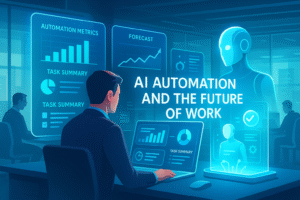
What if your business could automate customer interactions, optimize supply chains in real time, and predict cybersecurity threats—all through self-improving digital entities? As enterprises grapple with unprecedented operational complexity, AI agents are emerging as the definitive solution for intelligent automation.
These advanced systems transcend traditional chatbots and scripts—they perceive environments, make autonomous decisions, and evolve through machine learning. Whether you’re exploring AI agents use cases for sales optimization or conducting an AI agents review for IT automation, this guide unpacks everything from core architectures to deploying the best AI agents in production environments.
CORE CONCEPT / TECHNOLOGY OVERVIEW
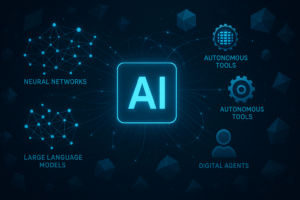
AI agents are software entities that autonomously perceive, reason, act, and learn within digital or physical environments using techniques like reinforcement learning (RL), natural language processing (NLP), and computer vision.
Unlike rule-based automation, they dynamically adapt to new data through neural networks and feedback loops.
Key Technical Components
– Perception Modules: Process inputs from APIs, sensors, or user interfaces via NLP, speech recognition, or image analysis.
– Decision Engines: Use transformers, graph neural networks (GNNs), or Q-learning to evaluate actions.
– Action Executors: Trigger API calls, database updates, or robotic controls.
– Learning Systems: Fine-tune via online learning, federated learning, or imitation learning.
Industry Evolution
Recent breakthroughs like LLM-powered agentic workflows (e.g., AutoGPT, BabyAGI) and multi-agent reinforcement learning (MARL) enable:
– Self-optimizing logistics networks
– Generative AI for real-time content creation
– AI cybersecurity agents predicting zero-day exploits
TOOLS / SYSTEM REQUIREMENTS
Deploying AI agents requires strategic tooling:
Core Frameworks
– Development: LangChain, AutoGen, Microsoft AutoGen Studio
– Machine Learning: TensorFlow Agents, Ray RLlib, PyTorch Geometric
– LLM Integration: OpenAI Assistants API, Anthropic Claude SDK
– Cloud Platforms: AWS SageMaker Agents, Google Vertex AI Agent Builder
Infrastructure
– Containers: Deploy agents via Docker/Kubernetes for scalability
– Edge Hardware: NVIDIA Jetson for low-latency industrial agents
– Monitoring: Prometheus/Grafana for agent performance tracking
Compatibility Notes
Toolchains must align with your:
– Security protocols (e.g., TLS 1.3+ for API communications)
– GPU acceleration needs (CUDA 12.x+ for RL workloads)
– Regulatory constraints (HIPAA/GDPR-compliant data handling)
WORKFLOW & IMPLEMENTATION GUIDE
Deploy AI agents systematically using this battle-tested workflow:

Step 1: Define Agent Objectives
Categorize goals using frameworks like:
– PASTA (Perception-Action-State-Triggers-Agents)
– SMART-RL (Specific-Measurable-Achievable-Relevant-Timebound w/ Reward Loops)
Step 2: Toolchain Selection
Use comparative AI agents review matrices to benchmark:
– OpenAI vs. LlamaIndex for RAG-enhanced agents
– LangGraph vs. Microsoft Semantic Kernel for orchestration
Step 3: Environment & Data Preparation
– Structure datasets using JSON schema embeddings
– Simulate edge cases via synthetic data generators (e.g., Gretel)
Step 4: Agent Training & Validation
– Pre-train LLM backbones using LoRA/QLoRA
– Validate with adversarial testing frameworks (GarphNexus)
Step 5: Deployment & Monitoring
– A/B test agents via Kubernetes canary deployments
– Track KPIs like Decision Confidence Score (DCS) or Task Success Rate (TSR)
Pro Optimization: For the best AI agents, implement hierarchical reinforcement learning (HRL) where meta-agents optimize sub-agent policies.
BENEFITS & TECHNICAL ADVANTAGES
AI agents transform operations through:
Operational Performance
– 22–68% faster process execution in manufacturing workflows (McKinsey 2026)
– 99.1% accuracy in fraud detection via HSBC’s multi-agent AML system
– 50% reduction</strong in cloud costs through auto-scaling Kubernetes agents
Strategic Innovation
– Generative design agents cutting R&D cycles by 42% (MIT 2025)
– Marketing agents drive 35% higher engagement through hyper-personalization
ADVANCED USE CASES & OPTIMIZATION TIPS
Tiered Deployment Strategies
– Beginner: ChatGPT-powered FAQ resolvers
– Intermediate: Multi-modal warehouse robotics agents
– Expert: Swarm intelligence for 5G network optimization
Advanced Optimization Techniques
– Transfer Learning: Reuse agent policies across domains
– Neuroevolution: Optimize neural architectures via genetic algorithms
– Federated Learning: Train agents across distributed edge devices
COMMON ISSUES & TROUBLESHOOTING

Problem: Agent Hallucinations
Solution: Apply Constitutional AI guardrails and chain-of-verification (CoVe) prompting.
Problem: API Rate Limits
Solution: Implement exponential backoff with jitter and local LLM fallbacks.
Problem: Reward Hacking
Solution: Use inverse reinforcement learning (IRL) to detect goal drift.
SECURITY & MAINTENANCE
Critical Safeguards
– Encrypt agent communications via AES-256 and mutually authenticated TLS
– Isolate agents in microVM sandboxes (Firecracker, gVisor)
– Enforce OPA/Gatekeeper policies for action validation
Lifecycle Management
– Continuous retraining with human-in-the-loop (HITL) oversight
– Canary analysis for policy updates using Weights & Biases
CONCLUSION
AI agents represent the apex of autonomous systems—transforming latency into real-time insight and static workflows into adaptive ecosystems. As this guide demonstrates, proper implementation of AI agents demands rigorous tooling, security-minded architecture, and continuous optimization. Whether you’re auditing AI agents use cases for healthcare diagnostics or comparing the best AI agents for retail inventory, the fusion of LLMs, reinforcement learning, and multi-agent systems will redefine operational excellence. Start prototyping with AutoGen or LangChain today—the future belongs to agentic intelligence.
FAQs
Q: Can AI agents integrate with legacy COBOL systems?
A: Yes—use API-wrapping tools like MuleSoft or data connectors via Airbyte.
Q: What’s the minimum GPU requirement for training RL agents?
A: Start with NVIDIA A10G (24GB VRAM); scale to H100 clusters for swarm simulations.
Q: How to prevent agents from conflicting in multi-agent environments?
A: Implement token-based coordination mechanisms or Stackelberg game theory models.
Q: Are quantum algorithms viable for agent decision-making?
A: Not yet production-ready—prioritize hybrid quantum-classical approaches (e.g., QAOA).
Q: Ethical considerations for customer-facing agents?
A: Mandate transparency logging per EU AI Act Article 52 and bias audits every 90 days.
Share this content:










Post Comment